

For too long, Scotland’s economic conversation has centred around attracting inward investment. International companies matter, of course. They create jobs, stimulate local economies, and bring global visibility.
But if Scotland wants long-term prosperity, resilience, and influence in the modern economy, we must become equally serious about building our own technology companies — from startup to scale-up and beyond.
The countries and cities winning in the 21st century economy are not simply those hosting multinational offices. They are the places creating globally competitive companies of their own.
Scotland has all the ingredients to do exactly that.
We have world-class universities, exceptional technical talent, internationally respected research capability, and a growing entrepreneurial culture. What we now need is sustained strategic alignment — between academia, government, investors, founders, and industry — to create a pipeline of Scottish companies capable of scaling globally while remaining rooted here.
At the centre of that opportunity sits the University of Edinburgh.
The Difference Between “Shallow Tech” and “Deep Tech”
Not all technology ecosystems are built in the same way.
Much of the global startup conversation over the past decade has focused on what might be described as “shallow tech” — businesses built primarily around software interfaces, consumer platforms, or relatively lightweight applications. These companies can scale quickly and attract significant investment, but they are often easier to replicate and can struggle to create long-term defensible advantage.
Deep tech is different.
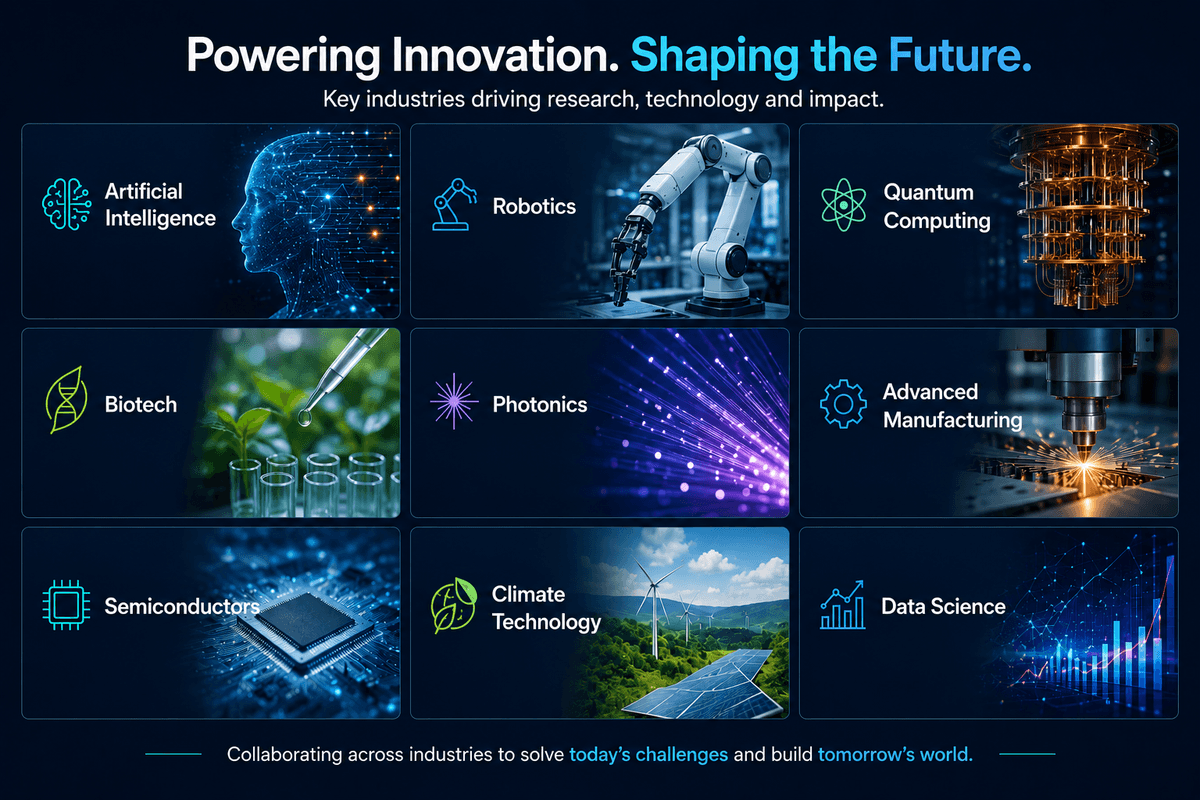
Deep tech companies are built around substantial scientific, engineering, or research breakthroughs. They often emerge from universities and research institutions and are rooted in fields such as:
- artificial intelligence
- robotics
- quantum computing
- biotech
- photonics
- advanced manufacturing
- semiconductors
- climate technology
- data science
These companies are typically harder to build, require longer development cycles, and need greater patient capital. But when successful, they create enormous long-term economic value because they are far more difficult to copy and often become globally strategic industries.
This distinction matters enormously for Scotland.
Competing globally in shallow tech alone is difficult. Large consumer markets, massive venture capital pools, and platform dominance heavily favour ecosystems such as Silicon Valley, Shenzhen, or London.
But deep tech creates a different opportunity — particularly for countries and cities with strong universities and advanced research capability.
That is where Edinburgh stands out.

Why Edinburgh Is Exceptionally Well Placed for Deep Tech
The University of Edinburgh is one of Europe’s leading research institutions and has developed a global reputation in artificial intelligence, informatics, robotics, data science, and engineering.
This is not simply academic prestige. It is economic infrastructure.

The University’s School of Informatics has long been recognised internationally as a leader in AI research, while initiatives such as the Bayes Centre and Edinburgh Innovations are actively focused on commercialising research and supporting entrepreneurial activity. (ed.ac.uk, ed.ac.uk)
Deep tech ecosystems are almost always university-led because advanced scientific and engineering breakthroughs tend to originate in research environments.
This is precisely how globally significant innovation clusters emerge:
- Stanford and Silicon Valley
- MIT and Boston
- ETH Zurich and Switzerland’s deep-tech ecosystem
- Eindhoven University of Technology and the Netherlands
- Technion and Tel Aviv
The lesson from all of them is consistent: great universities become magnets for talent, capital, founders, and research commercialisation.
Edinburgh has the potential to become one of Europe’s leading deep-tech cities because it already possesses many of the required ingredients:
- internationally respected AI capability
- strong data science expertise
- a globally recognised university brand
- growing entrepreneurial infrastructure
- increasing investor attention
- high quality of life that attracts talent
What matters now is building sufficient ecosystem density to allow research-intensive companies to scale from Scotland rather than relocating elsewhere.
Why Startups and Scale-Ups Matter
Startups are often discussed as small, risky ventures. But scale-ups are where transformational economic value is created.
When a technology company grows successfully, the benefits compound:
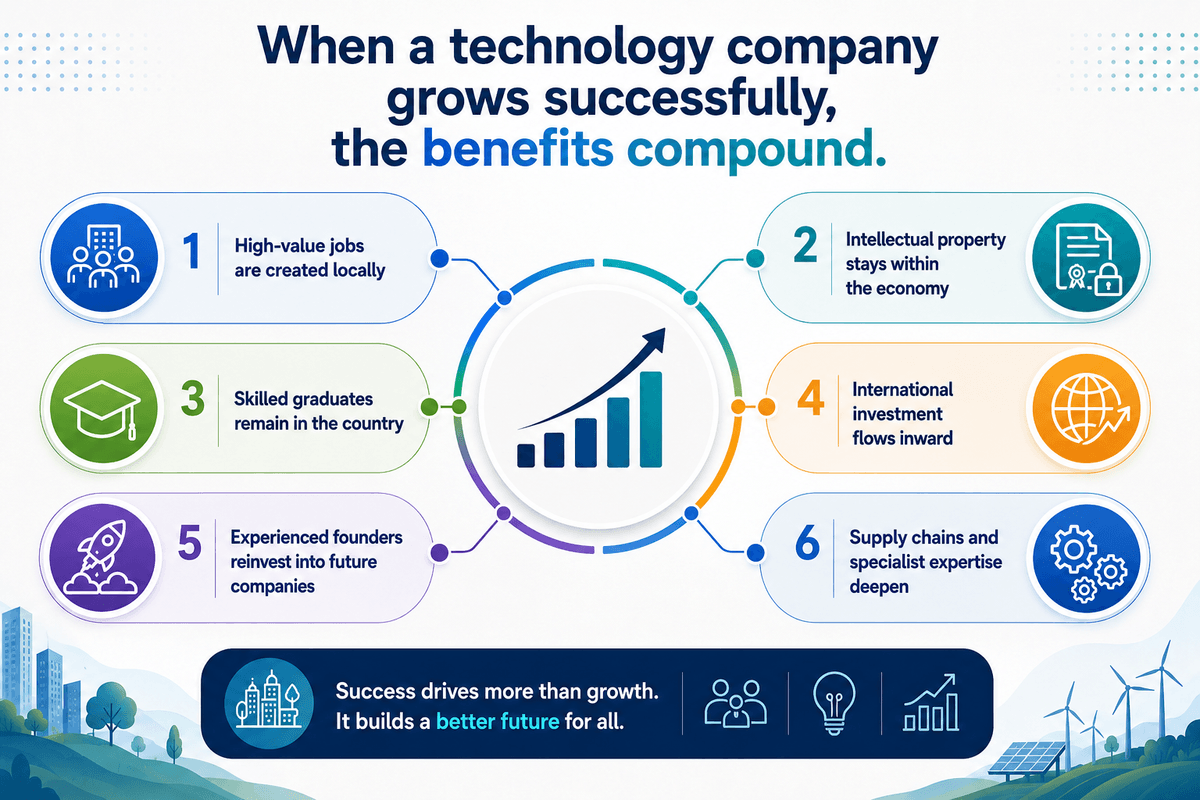
- high-value jobs are created locally
- intellectual property stays within the economy
- skilled graduates remain in the country
- international investment flows inward
- experienced founders reinvest into future companies
- supply chains and specialist expertise deepen
This flywheel effect explains why ecosystems such as Stockholm, Tel Aviv, and Singapore consistently outperform their size globally.
The objective is not simply to create startups... it is to create repeatable success.
Learning from International Success Stories
Around the world, successful startup ecosystems share common characteristics: strong universities, coordinated strategy, founder support, access to capital, and long-term policy alignment.
Stockholm
Stockholm invested heavily in digital infrastructure, technical education, and founder support long before startup ecosystems became fashionable. The result was globally significant companies such as Spotify and Klarna emerging from a relatively small country.
Tel Aviv
Israel deliberately built its startup economy through government-backed innovation funding, university collaboration, military technology transfer, and venture capital incentives.
While not every single start up in Isreal is considered " deep tech" a massive and growing portion is, with the country consistently ranking as a top five global deep tech hub nd the 1st outside of the US. Since 2019 over $28BN in venture capital has flowed into Israeli deep tech and life sciences.
The result is one of the world’s most concentrated deep-tech ecosystems.
Eindhoven
Eindhoven transformed itself from a manufacturing centre into a globally respected deep-tech hub through partnerships between universities, government, and industry leaders such as Philips and ASML.
Boston
Boston’s innovation economy demonstrates the power of research commercialisation. The ecosystem around MIT and Harvard became one of the world’s leading centres for biotech, robotics, AI, and advanced engineering.
These ecosystems were not accidents. They were built intentionally.
The Importance of CodeBase and Techscaler
Scotland has begun taking meaningful steps in this direction.
One of the most important developments has been the emergence of CodeBase as a national platform for startup ecosystem development.

Its importance extends far beyond office space.
CodeBase has helped create the connective infrastructure required for ecosystems to mature:
- mentorship
- founder networks
- educational programmes
- investor access
- peer learning
- international connectivity
This became even more significant through the Scottish Government-backed Techscaler programme.
Delivered by CodeBase, Techscaler was designed to support founders from idea-stage through to international scaling. The programme includes startup education, mentorship, workspace access, ecosystem events, and support across multiple Scottish cities. (techscaler.co.uk)
Importantly, Techscaler reflects a strategic recognition that startup ecosystems do not emerge organically at scale without coordination.
For deep tech in particular, this support infrastructure is critical because founders often require:
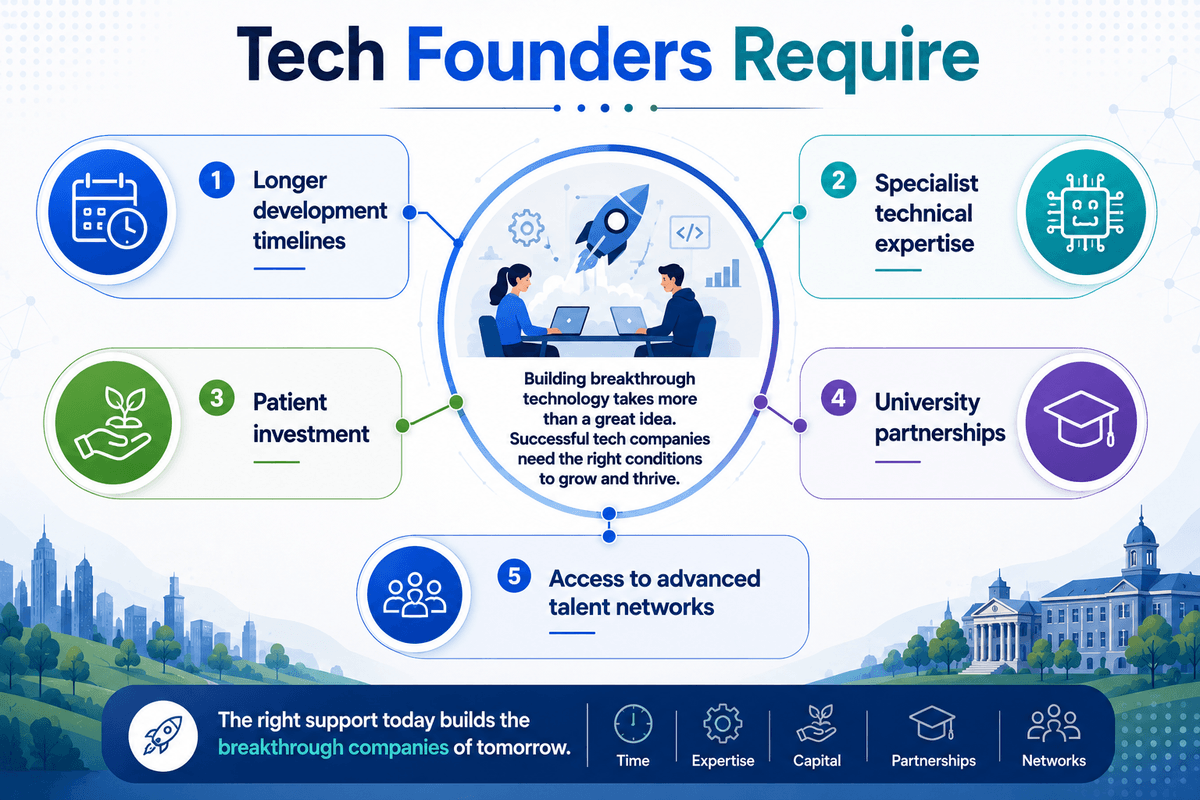
- longer development timelines
- specialist technical expertise
- patient investment
- university partnerships
- access to advanced talent networks
In that context, the relationship between Edinburgh’s universities, CodeBase, investors, and government becomes strategically vital.
Scotland’s Opportunity
Scotland now faces a defining economic opportunity.

The global economy is increasingly being shaped by countries and cities capable of creating advanced technology companies rooted in research, innovation, and intellectual property. Edinburgh is unusually well positioned for this moment.
The University of Edinburgh provides world-class research capability and deep technical talent.
CodeBase and Techscaler are helping build the entrepreneurial infrastructure needed to turn ideas into scalable businesses.
Scotland’s growing reputation in AI, fintech, climate technology, robotics, and data science creates genuine international opportunity.
But success will require long-term thinking.
We need:
- stronger university spin-out pipelines
- more patient deep-tech investment capital
- greater support for scaling companies
- procurement systems that encourage innovation
- stronger founder retention
- international market access
- deeper collaboration between academia and industry
Most importantly, we need confidence in Scotland’s ability to build globally significant companies of its own.
Because the countries that lead in deep tech will not simply generate economic growth.
They will shape the industries, infrastructure, and strategic power of the future global economy.
Scotland has the talent, institutions, and foundations to be one of them.